Socks cause more morning standoffs than almost any other piece of clothing. They sit inside shoes, under pressure, against feet that are full of nerve endings, and a single ridge across the toes can feel enormous. Here is how sock construction works and what to try when your child says their socks feel wrong.
Why socks are often the hardest item
A sock is squeezed between foot and shoe all day, so any flaw is pressed into the skin with every step. The toes are especially sensitive, and children often walk, run and jump in ways that make socks twist and slide. Add the fact that socks come in very few sizes, each meant to cover a range of feet, and it is easy to see why the fit is so often slightly off.
When a child complains, it is worth asking where. "The line" usually means the toe seam. "It's lumpy" may mean a heel that has twisted round to the top of the foot. "It's squeezing" usually points to the cuff, and "it's hot" may be about the fibre or the thickness rather than the construction.
Toe seams: the main culprit
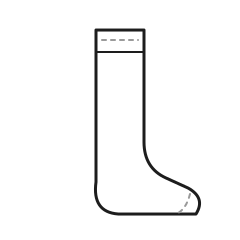
Most socks are knitted as a tube on a circular machine, starting at the cuff and finishing at the toe. That open end then has to be closed, and how it is closed makes a big difference.
Machine-closed toes
On many everyday socks, the toe is closed by overlocking the two edges together. This is quick and cheap, but it leaves a thick, raised ridge running across the toes, often with a little bump at each end. For a sensitive child, that ridge is frequently the whole problem.
Linked toes
Linking joins the two edges loop by loop, matching each stitch on one side to its partner on the other, so the closure is nearly as flat as the rest of the knit. It was traditionally done by hand ("hand-linked"), and machines can now do it too. Linked toes are what most socks described as "seamless" or "flat seam" actually have: there is still a join, but it is very hard to feel.
Seamless knit tubes
Some socks are knitted so the toe is closed on the knitting machine itself, as part of the same process, with no separate seam added afterwards. These can feel almost completely smooth. Product descriptions are not always precise about which method is used, so the most reliable check is to turn the sock inside out and run a finger across the toe.
Heels, cushioning and length
Heel fit
A shaped heel pocket holds the sock in place so the heel stays at the heel. If the sock is too big, the pocket slides up the back of the ankle or twists round to the top of the foot, creating a lump inside the shoe. Some children prefer heel-less tube socks because they cannot sit "wrong", though they can bunch at the front of the ankle.
Cushioning
Cushioned socks have terry loops on the inside of the sole, sometimes under the whole foot and sometimes only in the heel and ball. Many children like the padding, but the loops are a texture of their own, and a thick sole can make shoes feel tight. Thin, smooth socks suit children who want minimal sensation; cushioned ones suit those who like a softer, more muffled feel underfoot.
Sock length
- No-show and trainer socks avoid ankle bands, but they often slip down into the shoe, which some children cannot bear.
- Ankle socks sit just above the shoe and are a common middle ground.
- Crew socks reach up the lower leg and tend to stay in place better, but have a longer cuff.
- Knee-high socks, often part of school uniforms, need firmer elastic to stay up and may leave marks.
Compression feel and fibre choice
Children differ widely in how they feel about pressure. Some like a snug sock that hugs the foot and stays exactly where it is put; to them, a loose sock feels sloppy and distracting. Others dislike anything that grips, and a tight cuff can feel like a band around the leg. Check the cuff by stretching it over your hand: a soft, wide cuff spreads pressure, while a narrow, firm one concentrates it. Red marks on your child's leg at the end of the day are a sign the cuff is tighter than it needs to be.
Most children's socks are blends. Cotton gives softness and breathability; a little nylon or polyamide adds strength; elastane gives stretch and helps the sock keep its shape. A sock that is entirely cotton may feel soft but sag and bunch. Fine merino socks are warm, handle moisture well and stay fairly odour-resistant, which suits children whose feet get hot and sweaty; children who react to wool may still prefer cotton. Polyester and acrylic socks are hard-wearing and quick to dry but can feel warmer and less breathable. Viscose-based socks feel smooth and silky, which suits some feet and makes others slide around in their shoes.
Getting sock sizing right
Sock sizes usually cover a span of shoe sizes. A child at the bottom of that span may have extra fabric bunching at the toe; a child at the top may feel the toe seam pulled tight across their toes. Where you can, choose the size where your child's shoe size falls in the middle. Measure feet regularly, since children often grow between seasons without anyone noticing, and our kids' sizing and measurement guide has more on tracking growth.
Shoes matter here too. A sock that feels fine on a bare floor may become uncomfortable inside a tight shoe, where every ridge is pressed in harder. If socks are suddenly a problem, check whether the shoes still fit.
Morning routines and practical tricks
Socks are frequently the last thing to go on before leaving the house, which is exactly when everyone is in a hurry. A few changes to the routine can help.
- Do socks earlier. Putting socks on straight after getting dressed, rather than at the door, gives time to adjust them calmly.
- Try them inside out. This puts the toe seam on the outside, away from the skin. Many children find this solves the problem completely, at no cost.
- Let your child line them up. Children who are fussy about the toe seam often want to place it themselves. Show them how to pull the sock fully on and wriggle the seam over the tips of their toes rather than across them.
- Keep a basket of "approved" socks. Remove any pairs that have been rejected so mornings are not spent trying and discarding.
- Buy multiples of the winners. Identical socks also end the hunt for a matching pair.
- Retire worn pairs. Old socks can pill, felt or develop thin patches that feel very different underfoot.
For school days, check whether your child's uniform rules say anything about sock colour or length; the guide to uniforms and school dress codes covers how to approach that. And if socks are part of a broader pattern of clothing discomfort, the main sensory-friendly clothing overview is a good place to start.
This guide is general information about clothing comfort and fit. It is not medical advice and is not a treatment for any condition. Every child is different. If clothing causes persistent or severe distress, talk to your child’s doctor or an occupational therapist.