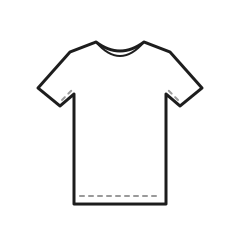
A T-shirt is the simplest garment most people own, and the one where small differences in fit are most visible. This guide works from the shoulders down, covering what to check on each part of the body, how necklines and cuts change the picture, and how to account for shrinkage before you buy.
Start at the shoulders
The shoulder seam is the anchor point for the whole garment. On a regular or slim tee, it should sit at the edge of the shoulder, roughly where the collarbone meets the top of the arm. A centimetre either way is fine. Much further in and the tee pulls across the upper back; much further out and the sleeve starts on the arm rather than at the shoulder, which makes the whole tee look a size too large.
The exception is the dropped shoulder. Boxy and oversized tees are often cut with the seam deliberately placed a few centimetres down the arm. In that case the seam position is part of the design, so judge the fit by chest ease, length and how the sleeve sits instead. A dropped shoulder that falls halfway to the elbow, however, is usually a sign of simply buying too big.
Shoulders are also the part of a tee that cannot be altered easily. If the body is slightly long but the shoulders are right, the tee is worth keeping. If the shoulders are wrong, nothing else will fix it.
Chest and body
Through the chest, a tee should skim rather than cling or billow. A useful test is to pinch the fabric at the side of the chest: on a regular fit you should be able to gather a few centimetres of fabric without strain. On a slim fit, a little less. On a boxy fit, considerably more, but the fabric should still fall straight rather than collapsing into folds.
Watch for horizontal pulling lines across the chest or the back, which mean the tee is too tight, and vertical folds under the arms, which mean there is excess fabric. Diagonal lines running from the shoulder towards the armpit usually point to a mismatch between shoulder width and chest, a common issue for people with broader shoulders relative to their chest, or vice versa.
Hem length
For a tee worn untucked, the hem should land around the middle of the trouser fly or the hip bone, covering the waistband with a little to spare. Raise your arms: a small flash of skin at full stretch is normal; exposure while simply reaching for a shelf means the tee is short.
Too long is the more common problem. A hem that falls past the crotch shortens the legs visually and bunches when sitting. If you intend to tuck the tee in, extra length is helpful, since it stays put when you move. Cropped and boxy styles are intentionally shorter and wider, which balances the extra volume; they are cut to sit at or just below the waistband.
Sleeves
Short sleeves on a classic tee usually end around the middle of the upper arm. The opening should sit close to the arm without gripping it; a gap of a finger or two is about right. Sleeves that flare out wide or reach towards the elbow give a looser, more relaxed look, which suits boxy cuts but can make a regular tee look shapeless.
A slightly shorter, narrower sleeve tends to look neater on most people, but there is no single correct length. Proportion matters more: a heavier, boxier tee can carry a longer, wider sleeve, while a lightweight slim tee looks best with a trim one. The way fabric weight affects these proportions is covered in our explainer on GSM and fabric weight.
Neckline types
Neckline choice changes the character of a tee more than almost any other detail.
| Neckline | Look | Fit points |
|---|---|---|
| Crew | Classic and versatile; works alone or layered under a shirt or knit | Should sit close around the base of the neck without choking. A rib that ripples or stands away has stretched. |
| V-neck | Opens the neckline and visually lengthens the neck; reads more casual the deeper it goes | A shallow V is the most versatile. A deep V is a stronger style choice and harder to layer. |
| Mock neck | Minimal and modern; a short, upright collar | Should stand close to the neck without pressing. Works best in a midweight or heavier fabric that can support the collar. |
| Scoop | Softer and more open, common in women's cuts | Should lie flat without gaping when you lean forward. |
Neck rib width is a small but telling detail. A narrow rib looks lighter and more refined; a wider rib looks more substantial and a little sporty. Either way, the rib should recover after you pull the tee on and off.
Boxy, regular and slim
Most tees fall into one of three cuts. None is better in absolute terms; each works with different proportions and different trousers.
- Slim: follows the body closely through chest and waist, with a narrow sleeve. Clean under jackets and with tailored trousers. Unforgiving if the fabric is thin.
- Regular: straight from chest to hem with modest ease. The most versatile option and the easiest to wear with anything.
- Boxy: wide through the body, often shorter, with a dropped shoulder and wider sleeve. Looks deliberate in heavier fabric and pairs well with straight or wide trousers.
As a rule, balance volume. A boxy tee works with straight or relaxed trousers; a slim tee works with almost anything but can look underweighted with very wide legs. A wardrobe built around a small set of versatile basics usually benefits from regular cuts first, with boxy or slim pieces added for variety.
Women's vs men's and unisex cuts
Women's tees are generally cut with a narrower shoulder, shaping through the waist, more room at the bust and hips, and often a shorter, narrower sleeve and a wider or lower neckline. Men's and unisex tees are usually cut straighter, with broader shoulders and a longer body.
Unisex sizing typically follows the men's pattern. For many women, that means the shoulders sit wide and the sleeves long; sizing down can fix the shoulders but may make the tee tight at the hips. Some people prefer exactly that relaxed, straight unisex shape, particularly in boxy styles. The useful habit is to compare the shoulder and chest measurements on a size chart rather than relying on the size letter. You can browse both directions in our women's and men's sections.
How shrinkage affects your choice
Cotton tees that are not pre-shrunk can lose some length, and occasionally a little width, over their first few washes, mostly when tumble dried. If a cotton tee fits perfectly in the fitting room and the label does not mention pre-shrinking, expect it to be slightly shorter after a month.
- If you dry on a line or flat, buy the size that fits now.
- If you tumble dry regularly, consider a tee that is a touch long to begin with.
- Garment-dyed tees are often already washed during dyeing and tend to shrink less afterwards.
For the full picture of why cotton shrinks and how to slow it, see our guide on keeping cotton tees from shrinking.