Cotton shrinks for a specific, well-understood reason, and once you know it, keeping tees and sweatshirts at their original size is mostly a matter of two settings: temperature and drying. This guide explains the mechanics, the labels to look for, a routine that works, and what to do when a favourite piece has already come out smaller.
Why cotton shrinks
Cotton yarns are pulled, twisted and held under tension at almost every stage of manufacturing: spinning, knitting or weaving, dyeing and finishing. The finished fabric is, in effect, slightly stretched, and it stays that way only while it is dry and undisturbed.
When cotton gets wet, its fibres absorb water and swell, and the tension locked into the yarns is released. Add heat and movement and the yarns settle back towards a more relaxed, shorter state. This is called relaxation shrinkage, and it accounts for most of the shrinking people notice in the first few washes.
Knitted fabrics such as jersey, terry and fleece are more prone to it than tightly woven ones, because the loops of a knit can rearrange and compact more freely. The effect is usually greatest in length, which is why a tee often ends up shorter but not noticeably narrower.
The tumble dryer does the most damage. Heat combined with constant tumbling keeps pushing the loops closer together while the fabric is still damp and pliable. Many people blame the wash for shrinkage that actually happened in the dryer.
What pre-shrunk and compacted mean
Because relaxation shrinkage is predictable, mills can remove much of it before the fabric is cut.
- Pre-shrunk is a general term meaning the fabric or garment has been treated so that most of its shrinkage has already happened.
- Compacting is a mechanical finish used on knits. The fabric is fed through rollers that push the loops closer together lengthwise, so there is less left to relax later.
- Sanforizing is a similar controlled-shrinkage process for woven cotton, such as shirting, chino twill and denim.
- Garment-dyed pieces are dyed after sewing, which involves hot water and agitation, so much of the shrinkage tends to happen at the factory.
None of these makes a fabric completely shrink-proof. They reduce residual shrinkage to a small amount, which a careful routine can keep close to nothing. Labels do not always mention these finishes, so a lack of the words does not prove a garment will shrink a lot. Our guide to understanding fabric labels explains what care symbols and fibre content can tell you.
Choosing a wash temperature
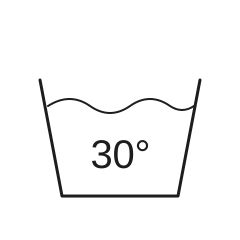
For cotton tees, sweatshirts and knitwear, wash cold or cool, around 30 °C (86 °F) or below. Modern detergents are formulated to clean well at these temperatures, and a cool wash removes most of the heat from the shrinkage equation.
A few further habits help:
- Use a gentle or delicate cycle for knits. Less agitation means less compaction of the loops.
- Turn garments inside out. It protects the outer face from abrasion and reduces pilling.
- Do not overload the drum. Clothes need room to move without twisting around each other.
- Wash similar weights together. Heavy items like towels and jeans rub against lighter knits and pull them out of shape.
Warmer washes still have their place for towels, bedding and heavily soiled items, as long as the care label allows. It is everyday tees and sweatshirts that benefit most from a cool routine.
Drying: where most shrinkage happens
If you change one thing, change the drying. Options in order of gentleness:
- Dry flat. Lay the garment on a rack or towel and smooth it into shape. Best for heavy knits and sweatshirts, which can stretch under their own weight on a line.
- Line or hanger dry. Fine for tees. Hang by the hem or over a rail, or use a wide hanger, rather than pegging at the shoulders, which can leave marks and stretch the neck.
- Low-heat tumble. If you use a dryer, choose the lowest heat and take the garment out while it is still slightly damp, then finish drying flat or on a hanger.
Avoid high-heat tumble drying for anything cotton you want to keep at its current size. Over-drying, running the dryer long after the fabric is already dry, is the most reliable way to shrink a tee and also wears out elastic and prints.
Reshaping while damp
Cotton is most pliable when damp, and that is the moment to set its shape. As you take a garment out of the machine, give it a firm shake, then gently pull the body lengthwise and the side seams straight. Ease the neck rib back into a neat curve and smooth the hems flat.
Check that side seams run straight down the body rather than twisting towards the front. Some twist is built into certain knits and will return, but a quick tug while damp keeps it from setting at an odd angle. Sweatshirt cuffs and hems can be pressed gently together with your hands so the ribbing dries closed rather than flared.
If it has already shrunk
Some recovery is often possible, but it is worth being realistic. You may regain a little length, not the original size, and results vary with the fabric and how much it shrank.
- Fill a basin with lukewarm water and add a small amount of hair conditioner or a gentle shampoo. These can help the fibres slip past one another a little more easily.
- Soak the garment for around half an hour, working the solution through gently.
- Press out excess water without wringing. Rolling it in a towel works well.
- Lay it flat and stretch it gently and evenly in the direction it shrank, usually lengthwise. Work in small stages rather than one hard pull.
- Let it dry flat, reshaping a couple of times as it dries. Placing light weights at the hem can help hold the length.
Expect the fabric to feel slightly different afterwards, and expect it to want to return towards the shrunken size if it goes back into a hot dryer. Blends containing synthetic fibres or elastane respond less predictably; avoid heat with these entirely. If a tee is now too short to wear as before, it may still work as a base layer or for sleep, where length matters less.
Buying with shrinkage in mind
The simplest defence against shrinkage is choosing well in the first place. When a cotton tee or sweatshirt is not described as pre-shrunk or garment-dyed, and you plan to tumble dry it, a little extra length at the start is sensible. If you air-dry everything, buy the size that fits now. Our guide to judging tee fit covers how much hem length to look for.
Fabric construction matters too. Dense, well-compacted knits generally hold their size better than loose ones, a point explored in our piece on what fabric weight tells you. And because children's clothes go through the machine more than anything else, the same principles are adapted in our care guide for kids' clothing.